

Basic Attachment
Have you ever noticed how strange it is that two siblings can have totally different social styles even when raised by the same parents in identical environments? Such as the oldest sibling being well rounded and even keeled while the other constantly changes their mind. This is an example of how attachment styles developed during infancy can appear later in life. To understand attachment we first need to understand what it means. As common as this term is, it is often simply defined as a long standing connection or bond with another. This connection varies greatly between different types of attachment. To give you an example there was a study done by a man named Harry Harlow.
In this study they took infant rhesus monkeys and separated them from their mothers. In place they were given 2 surrogate mothers. One surrogate was made of wire mesh and could dispense milk. The other was made of soft cloth but was not able to dispense milk or any type of nourishment.
The study results showed that the infants bonded with the cloth mother despite not being able to get sustenance from it. They only went to the wire mesh mother to consume milk and then returned to the cloth mother. This study led to the conclusion that the mother child bond goes beyond simply nourishment and is grounded in feelings of comfort and security. This was a seemingly small study that has been criticized for the harm it caused the infant monkeys, but led to additional studies deeper into this subject.
Attachment Theory
John Bowlby was the developer of Attachment Theory. In his theory he focused again on infants who are generally a blank slate for attachment compared to older children or adults who apply cognitive reasoning to their attachments. Bowlby’s theory was that infants must form a bond with a primary caregiver in order to have normal social and emotional development. This may be deemed as common knowledge by some but in actuality it was Bowlby’s large influence over developmental psychology that made this a more widely known topic.
Bowlby indicated that through his study there were two things required to create a healthy attachment.
- The caregiver must respond to the physical, social and emotional needs of the infant in a timely and appropriate manner.
- The child and caregiver must engage in mutually enjoyable interactions.
Following Bowlby was a woman by the name of Mary Ainsworth who developed the Ainsworth strange situation procedure. The procedure was to test the bond between primary caregivers and infants. The process had eight stages or episodes in which a mother was used as the caregiver as was customary in the 1960s.
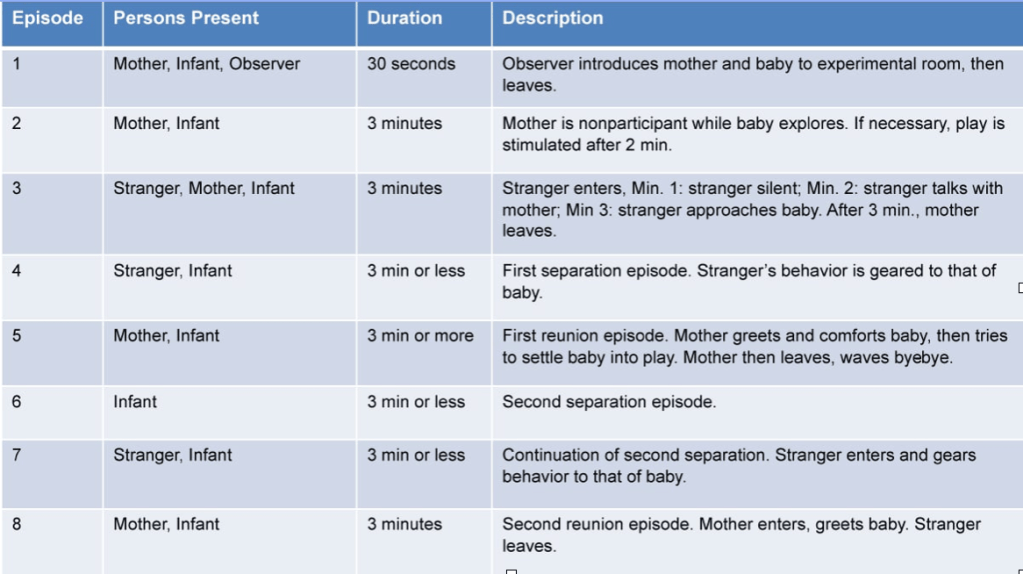
The way in which the infant responded in each episode was an indicator of their attachment style of which 4 were identified.
- Secure Attachment: This is the most common form of attachment and the healthiest. This can be reflected later in life as a well rounded person with stable relationships and emotional regulation.
- Insecure Avoidant Attachment: In this style the infant would avoid contact with the caregiver as well as the stranger. With this style children learn early to be independent and tend to be disengaged. In adulthood this style typically translates to emotional insecurity, shyness, and pulling away from a relationship when it becomes serious/real.
- Insecure Resistant/Ambivalent: This indicates when the infant is resistant to engage in any activity or play when separated from the caregiver. It is normally driven by inconsistent caregiver behaviour, particularly in reaction to the child’s needs and caregiver availability. It is important to understand this could be part of the child’s natural temperament and is not a sign of neglect. In adults this is usually what some call a clingy person. They have an overwhelming fear of abandonment and have a deep need for emotional closeness.
- Disorganized: This is marked by inconsistent reactions to similar or identical circumstances. Disorganization occurs when the infant is given mixed, inconsistent, confused, or inappropriate responses by the caregiver. This is sometimes reflected in adulthood as indecisiveness and fear of making the wrong choice.
“From the cradle to the grave, human beings are hardwired to seek… proximity to special others who are deemed irreplaceable.”
–John Bowlby
Why Is This Important?
It is important to understand attachment for several reasons. These 4 styles of attachment can tell a lot about how a child has been developing as well as a general trajectory based on current attachment style. They also can be a great way to understand oneself. When you understand your own attachment style it helps you see the patterns in those around you, allowing you to be more understanding and empathetic of others. No matter what stage of life you are in – if you are raising kids, in a relationship, flying solo, or even retired – there is something to be gained from understanding Attachment Theory.
Conclusion
Attachment is a core and vital part to not just our society but our individuality. It is part of who we are and why. I would encourage you to read more material on topics like this to help you better understand not just your children but yourselves as well. If you learned even one thing from this please subscribe to the email list. I do not send out weekly emails and will not flood your inbox. You will only get messages as content is published or when major updates are happening to the site or its content.
References
Bowlby, J. (1988). A secure base: Parent-child attachment and healthy human development. Basic Books.
McLeod, S. (2026, July 27). Mary Ainsworth Strange situation experiment. Simply Psychology. https://www.simplypsychology.org/mary-ainsworth.html
PSYCHOLOGY NOTES HQ EDITORIAL STAFF. (2026, May 15). Ainsworth attachment styles: All 4 types & what they mean. The Psychology Notes Headquarters. https://www.psychologynoteshq.com/attachment-theory/#google_vignette

